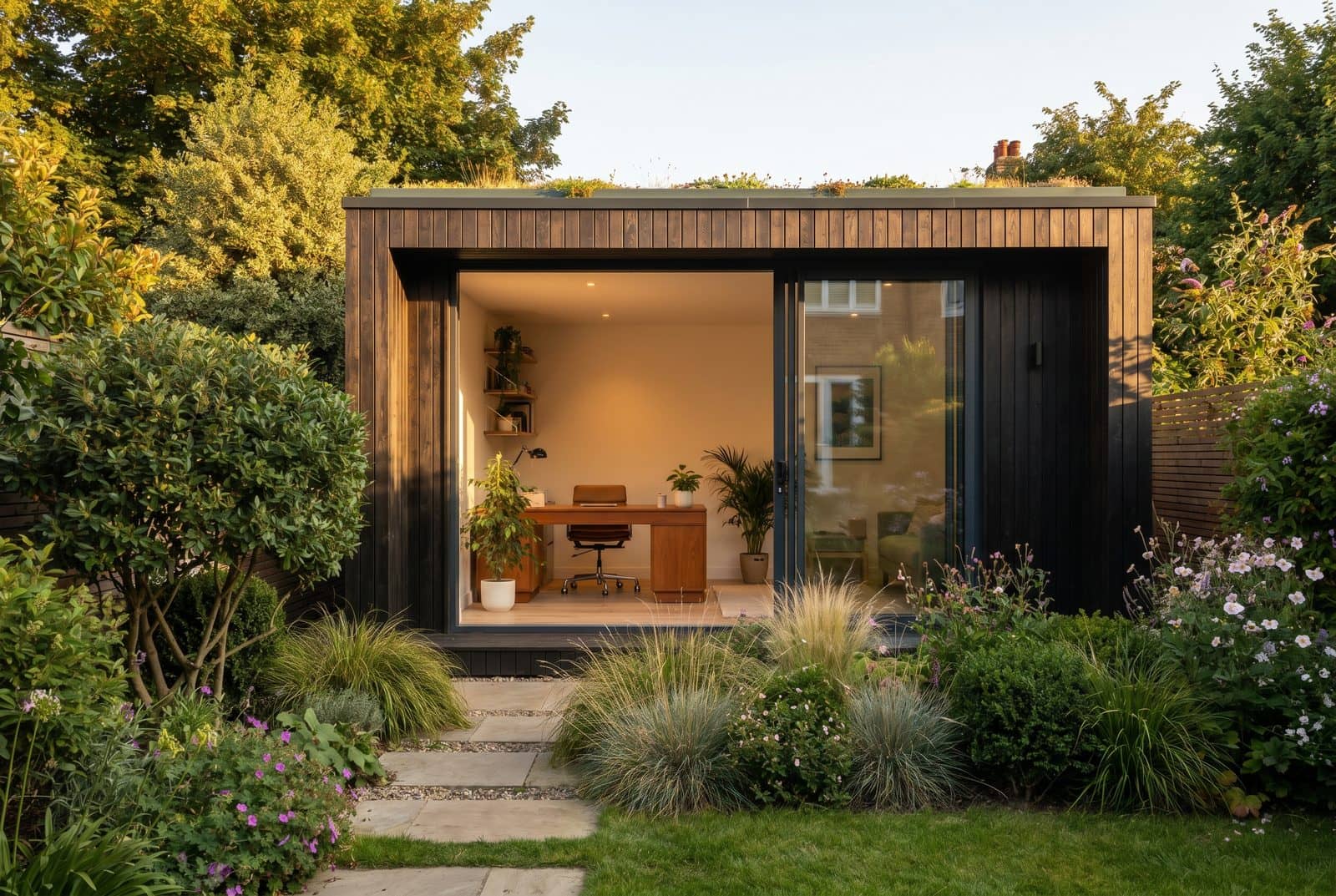
A garden room is the fastest way to add a proper, usable room to a London home without the disruption, planning battles or six-figure budget of a full house extension. Done properly — with real foundations, full insulation and mains power — it works in January as well as July, and it goes up in weeks, not months. The Extension Company is the extensions studio of Pine Grove Design & Build: one team designs your garden room and prices it as a fixed quote, and in North London Pine Grove's own team builds it. No surprise costs at the end.
What does The Extension Company build?
We build permanent, insulated garden rooms designed for year-round use — not summerhouses, not flat-pack kits. Every build is bespoke to your garden, your use and your budget, and every quote is fixed before we start.
- Fully insulated, year-round structures. Floor, walls and roof are insulated to a standard that keeps the room warm in winter and cool in summer, so it is genuinely usable 365 days a year — not a fair-weather shed.
- Design-and-build, one team. We handle design, the planning position, foundations, structure, electrics and finish as one job. One point of contact from first sketch to handover.
- Fixed price. You get an itemised, fixed quote after a free site visit. The number we agree is the number you pay — foundations, electrics and VAT included, not bolted on later.
- Built to last. Proper concrete or screw-pile foundations, treated timber frame, quality cladding and a 3–6 week build.
If the room is going to be a home office, studio or gym used every day of the year rather than a summer retreat, the insulation and foundation spec matters more than the cladding.
What can a garden room be used for?
The structure is similar; the internal spec and services change with the use. Below are the usual briefs for a London garden room, with realistic finished, all-in costs (foundations, electrics and VAT included) for a year-round room.
| Use | Typical size | What it includes | Finished cost (London, 2026) |
|---|---|---|---|
| Garden office | 10–15 m² | Insulation, power, lighting, data, double glazing | £18,000 – £35,000 |
| Studio / hobby room | 12–18 m² | As office, plus enhanced lighting/acoustics | £22,000 – £38,000 |
| Garden gym | 15–25 m² | Reinforced/rubber floor, ventilation, power | £28,000 – £45,000 |
| Snug / TV room | 12–18 m² | Insulation, heating, power, glazing | £22,000 – £38,000 |
| Garden room with kitchenette + bathroom | 20–30 m² | Plumbing, drainage, kitchen, WC/shower | £30,000 – £55,000 |
Three things drive the price within each band: size (the single biggest factor), how much glazing you want, and whether you add water and drainage. A garden office with a single socket and a window sits at the bottom of its range; the same footprint with a bathroom and bifold doors sits at the top. Our garden room cost guide breaks the price down by use, by square metre and by what the headline figure leaves out.
Do you need planning permission for a garden room?
This is the single biggest selling point of a garden room, and it is worth understanding clearly. Most garden rooms in London are permitted development — meaning no full planning application — provided they stay within the rules. We confirm your exact position before you commit.
Your garden room is normally permitted development if all of the following are true:
- It is single-storey, with eaves no higher than 2.5m.
- The maximum height is 2.5m if it sits within 2m of any boundary; otherwise up to 3m (or 4m for a dual-pitched roof) elsewhere in the garden.
- It is not used as self-contained living or sleeping accommodation — a bedroom or independent annexe needs full planning permission.
- It covers no more than 50% of the total garden area.
| Situation | Planning position |
|---|---|
| Single-storey, ≤2.5m near boundary, office/gym/studio use | Usually permitted development |
| Within 2m of boundary, height kept to 2.5m | Permitted development (height-limited) |
| Used for sleeping / as a separate annexe | Full planning permission required |
| Listed building or conservation area | Restricted — check before building |
| Covers more than 50% of the garden | Full planning permission required |
Three practical points. First, conservation areas (Monken Hadley, Highgate, Winchmore Hill Green and Hadley Wood among them) and listed homes have tighter rules, so we always check first. Second, even when you do not need planning, a Lawful Development Certificate (£274) is a wise, low-cost way to prove the build is legal — useful when you sell. Third, building regulations are separate from planning. A detached garden room under 15 m² with no sleeping accommodation is normally exempt; from 15 m² to 30 m² it stays exempt only if it sits at least 1m from every boundary or is built substantially of non-combustible materials; above 30 m², or with sleeping accommodation, it needs approval. We handle all of this for you.
How does it work? Four steps
We keep the process simple and predictable, which is how a typical garden room goes from enquiry to finished room inside a couple of months.
- Free site visit. We come to your London garden, measure up, talk through how you'll use the room, and check the planning and building-regs position on the spot.
- Fixed quote and design. You receive an itemised, fixed-price quote and a design for your exact garden — foundations, electrics and VAT all included, nothing hidden.
- Foundations and build. In North London, Pine Grove's own team lays proper foundations, erects the insulated timber frame, fits cladding, glazing, electrics and internal finishes. Most builds take 3–6 weeks on site.
- Handover. We hand over a finished, decorated, powered room ready to use — plus your Lawful Development Certificate paperwork where relevant.
Because one team owns the whole job, there is no gap between trades and no finger-pointing if something needs adjusting.
Garden room guides
One question per guide, in more depth than this page can go:
- Planning and the rules: do you need planning permission for a garden room? · the outbuilding rules for sheds, summerhouses and garden buildings, including the 2.5m boundary rule · granny annexe rules, for when the room is to be slept in
- The big decision: a garden room or an extension? · is a garden room cheaper than an extension?
Why do foundations and insulation matter?
It is tempting to compare our quote with a cheap online "garden room" kit, but you are not comparing like with like — and the difference shows up in winter and at resale.
- Foundations. A proper concrete or screw-pile foundation (£1,500–£5,000 of the build) stops the structure shifting, sinking or twisting on London's clay soils. Cheap kits often sit on paving slabs or a timber frame on the ground, which moves with the seasons and can rot.
- Insulation. Full floor, wall and roof insulation is what separates a year-round room from a summerhouse. Without it, a "garden office" is unusable for the three or four coldest months — so you have effectively paid for a room you can use two-thirds of the year.
- Glazing and weatherproofing. Double glazing, proper flashing and a sealed building envelope keep heating costs down and condensation out. Single-glazed, poorly sealed kits sweat and leak.
- Electrics and compliance. A mains supply on its own certified circuit, installed to current regs, means you can heat, light and work in the room safely and legally — not run an extension lead across the lawn.
Spend the money on the parts you cannot see — the foundation and the insulation — and the room lasts decades and adds value. Skimp on them and you have an expensive shed.
Which areas of London do you cover?
We cover North London and across London. North London garden rooms are designed, managed and built by Pine Grove's own team, in areas including:
- Cockfosters, Hadley Wood and Barnet (EN4, EN5) — where Hadley Wood and Monken Hadley are conservation areas, so check the rules before siting the room.
- Enfield, Southgate and Oakwood (EN1–EN2, N14) — interwar semis with long rear gardens.
- Winchmore Hill, Palmers Green and Muswell Hill (N21, N13, N10) — period homes where careful design matters.
We also cover South London. See every town and postcode we serve on our locations page; wherever you are, the free site visit and fixed quote work the same way.