20m² Kitchen Extension Cost: What North Londoners Really Pay
Real 2026 numbers: £56,000–£84,000 for the 20m² shell, £8,000–£25,000 for the kitchen, £75,000–£110,000 all-in. Every extra itemised, no surprises.
Last updated: June 2026 · Figures checked against live North London quotes and current government fee schedules.
How much does a 20m² kitchen extension cost?
Quick answer: A 20m² kitchen extension in North London costs £56,000–£84,000 to build in 2026, plus £8,000–£25,000 for the kitchen itself. Once professional fees, glazing upgrades and VAT are counted, most completed projects land between £75,000 and £110,000 all-in.
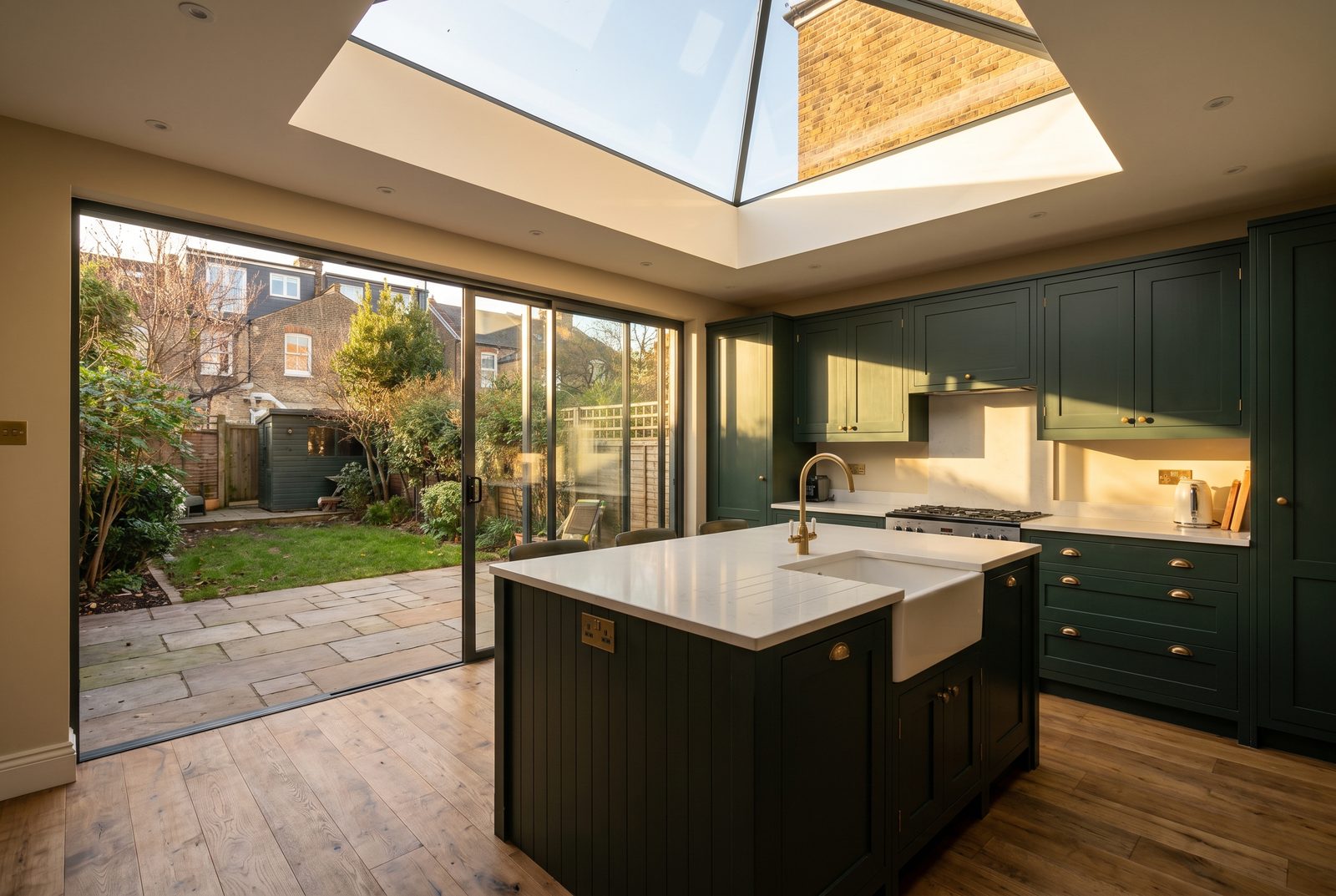
Twenty square metres — a 4m x 5m box, give or take — is the canonical kitchen-diner: island, dining table, sofa corner, garden wall of glass. It is also the project where headline build rates and final bank statements part company most dramatically, because the build price never includes the kitchen, and the kitchen is the point. This article reassembles the whole bill the way it actually arrives, using current North London tender prices rather than national averages from three fee rises ago.
What does the 20m² shell and build cost?
At today's North London rates of £2,800–£4,200 per m², the construction of a 20m² extension prices at £56,000–£84,000 excluding VAT. On premium streets where £3,500–£5,000+ per m² rules, the same footprint runs £70,000–£100,000. That money buys the structure complete: foundations into London clay, steels, insulated warm roof, basic glazing allowance, first and second fix services, plaster, screed and decoration. What it does not buy — ever — is a single cabinet, appliance or worktop. Treat any "kitchen extension" price that fails to separate building from kitchen as unfinished arithmetic.
How much should you allow for the kitchen itself?
Units, worktops and fitting span £8,000–£25,000 in practice. Around £8,000–£12,000 covers a well-specified trade or flat-pack range professionally fitted; £12,000–£18,000 buys mid-market doors, quartz worktops at £2,000–£4,500 and better internals; £18,000–£25,000 enters in-frame and semi-bespoke territory. Appliances ride on top at £2,500–£6,000 for the usual induction-oven-fridge-dishwasher line-up. A useful planning ratio from real projects: the kitchen tends to absorb 15–25% of the total spend, and squeezing it below that on a £90,000 project usually disappoints daily for the next twenty years.
What do glazing and roof lanterns add?
Glass is the upgrade that photographs best and inflates quietly. Against a baseline of uPVC French doors at around £1,800 fitted, aluminium bifolds or sliders across a 4–5m opening cost £6,000–£15,000 installed, a roof lantern adds £2,500–£6,000, and fixed flat rooflights run £1,200–£2,500 apiece. Stack a slider, a lantern and two rooflights and you have put £12,000–£20,000 of glazing into a 20m² room — sometimes worth every penny for a north-facing plot, but it should be a decision, not a discovery on invoice four.
Which extras should be on your budget sheet?
| Item | Typical cost (2026) | Notes |
|---|---|---|
| Design and drawings | £1,200–£2,500 | Plans, elevations, building regs package |
| Structural engineer | £500–£1,500 | Steel calcs for the rear opening |
| Building control | £500–£1,500 | Council or approved inspector |
| Party wall surveyor | £700–£2,500 per neighbour | Most attached houses trigger the Act |
| Prior approval (larger home extension) | £249 | For 4–6m deep schemes on attached houses |
| Householder planning application | £548 | Current fee from 1 April 2026 |
| Kitchen units, worktops, fitting | £8,000–£25,000 | Appliances £2,500–£6,000 extra |
| Roof lantern upgrade | £2,500–£6,000 | Above basic rooflight allowance |
| Sliding or bifold doors | £6,000–£15,000 | Versus £1,800 French-door baseline |
Stacked together, these soft costs and upgrades typically put £15,000–£35,000 on top of the bare construction figure — precisely the gap between the rate-card arithmetic done at the start of a project and the bank transfers made by the end of it. Listing them on day one, with a figure against each, is what keeps a £90,000 project from quietly becoming a £115,000 one.
Which planning route applies to a 20m² kitchen extension?
Depth decides it. Keep a single-storey scheme to 3m deep on an attached house (so 20m² achieved as roughly 3m x 6.7m, often as a wrap) and you are normally within permitted development — evidence it with a £274 lawful development certificate. Push to the popular 4m x 5m shape and an attached house exceeds the 3m limit, which routes you through the larger home extension scheme: a prior approval application at £249, a 21-day neighbour consultation, and depths of up to 6m allowed if no amenity objection sticks. Schemes outside both regimes need a householder application at £548 — the fee that rose from £258 to £528 in April 2025 and to £548 in April 2026, so distrust any guide still quoting the old numbers. Submitting via the Planning Portal attracts a £91.02 handling charge that disappears if you pay the council directly. Conservation areas, Article 4 streets and flats lose these shortcuts entirely.
What does it all add up to? A complete worked example
A 4m x 5m kitchen extension on an Enfield semi, mid-range finish, one attached neighbour: construction at £3,400 per m² gives £68,000, and VAT at 20% lifts it to £81,600. Add a £14,000 kitchen with appliances, £2,000 of design work, £1,000 of structural engineering, £1,200 of building control, £1,400 of party wall fees and the £249 prior approval, and the project completes at £101,449. Lean versions — 3m-deep wrap within permitted development, French doors, an £8,000 kitchen, standard finish — can finish in the high £70,000s, while a premium-street build with sliders, lantern and bespoke cabinetry passes £110,000 without trying. Hence the honest range North Londoners really pay: £75,000–£110,000.
Frequently asked questions
Can we live in the house while the kitchen extension is built?
Most families do. The painful stretch is the 4–8 weeks between the old kitchen coming out and the new one commissioning — a plumbed-in temporary kitchenette in the dining room, agreed with the builder upfront, makes it survivable.
How long does a 20m² kitchen extension take?
Twelve to sixteen weeks on site for a well-run project, after 8–12 weeks of design and approvals. Insist the programme and the stage payments reference the same milestones, so a slipping schedule costs the builder leverage rather than you money.
Is a 3m-deep version much cheaper than 4m?
Modestly — you save roughly 5m² of build (£14,000–£21,000 at current rates) and may avoid the prior approval stage. But the £249 application is trivial against the extra 25% of floor area, so choose on layout, not paperwork.
Do I need an architect, or does design-and-build cover the drawings?
Either route works. A design-and-build firm produces plans, engineering and the building regs package under one fixed price, removing the classic gap where independent drawings tender far above the design-stage estimate. Complex or conservation schemes can still justify a separate architect.
What causes the nastiest cost surprises on kitchen extensions?
Below-ground items: deeper foundations near trees, rerouted drains and unmapped manholes, plus steel redesigns over wide openings. A contingency of 10% — £8,000 or so on this size of project — turns most of those shocks into line items.
Get the whole 20m² picture — build, kitchen, glazing and fees — as one fixed price from a Cockfosters-based design-and-build team. Start with the Extension Builder or arrange your free site visit on 020 3051 9430.
Related service
Kitchen Extensions — fixed-price design & buildOpen-plan kitchen extensions across North London — design, planning and build under one itemised price.
Thinking about your own extension?
Design yours in the Extension Builder for an honest guide price in 60 seconds — no email needed — or book a free site visit for a fixed, itemised quote from the Pine Grove team.
Or call us — 020 3051 9430
The London extension breakdown, in your inbox
One thoughtful piece a week on what extensions actually cost in London, what councils are approving, and the mistakes worth avoiding. No fluff, no spam, unsubscribe in one click.
We'll only email you about London extensions. Unsubscribe any time.
Explore More House Extension Design Options
Related Articles
What actually moves a kitchen extension quote in London: structural openings, glazing, roof type, drainage and finishes — plus the fees that are fixed.
Side return, rear or wrap-around? 2026 North London kitchen extension costs per m² with worked totals, planning rules, open-plan structure — and how to choose the right kitchen extension company in Barnet, Enfield and Haringey.
Many single-storey rear extensions are permitted development — 3m attached or 4m detached, 6m/8m via prior approval. When you need permission in 2026.
Ready to Get Started?
Henry Lewis
Henry Lewis covers UK home extensions, planning permission, and renovation for The Extension Company. He has spent the last decade writing about property and the British housing stock, with a particular focus on how London homeowners navigate the planning system and get the most from their builds.