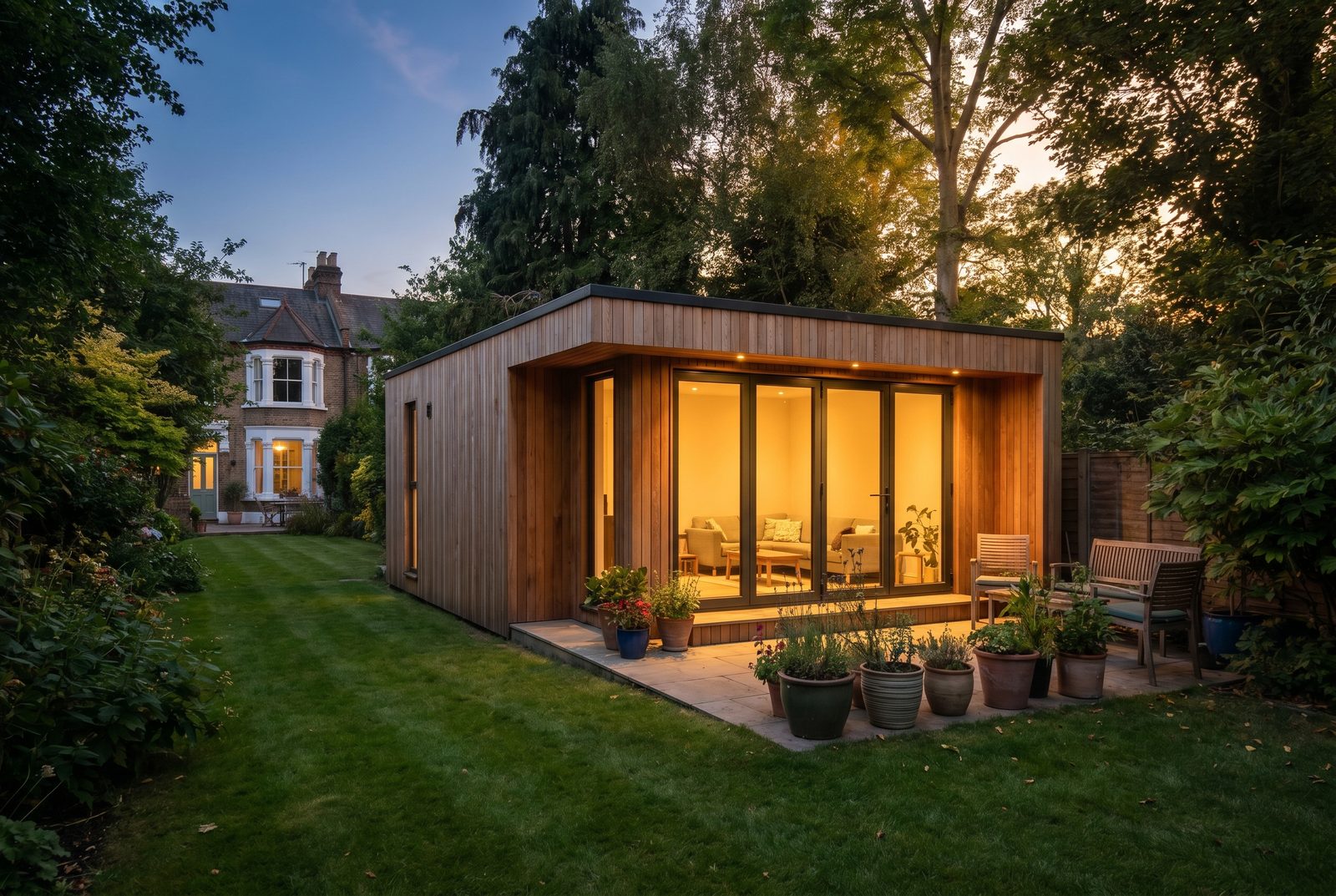
Do I Need Planning Permission for a Garden Room?
Most garden rooms are permitted development if single-storey, under 2.5m at the eaves, and not used for sleeping. The exact 2026 limits explained.
Last updated: June 2026 · Verified against current government planning rules and North London council records.
Do I need planning permission for a garden room?
Quick answer: Usually no. A garden room is normally permitted development if it is single-storey, no more than 2.5m high at the eaves where near a boundary, covers under half the garden, and is not used for sleeping or as self-contained living accommodation. Cross any of those lines and planning permission is required.
Garden rooms — home offices, studios, gyms, garden bars — have become one of the most popular ways to add space without touching the house. The big appeal is planning: get the dimensions right and you never file an application. But the permitted development rules for outbuildings are specific, and the single most common mistake is treating a garden room as a place to sleep, which instantly takes it outside permitted development. This guide sets out exactly where the lines sit in 2026.
What makes a garden room permitted development?
A garden room qualifies as permitted development when it meets all of the outbuilding conditions together. The structure must be single-storey. It must not exceed 2.5m in height where it sits within 2m of any boundary; away from boundaries a dual-pitched roof can reach 4m and other roofs 3m. Together with other outbuildings it must not cover more than 50% of the land around the original house. It must be for a purpose incidental to the enjoyment of the house — office, gym, studio — and crucially it must not be used as separate, self-contained living accommodation or for sleeping. It must also sit behind the principal elevation of the house, not in the front garden.
When does a garden room need planning permission?
Several triggers push a garden room into needing a full application. The table lists the common ones.
| Trigger | Why permission is needed |
|---|---|
| Used for sleeping or as self-contained accommodation | This is no longer incidental use and falls outside permitted development |
| Over 2.5m high within 2m of a boundary | Exceeds the height limit for boundary-adjacent outbuildings |
| Two storeys, or with a mezzanine sleeping deck | Permitted development covers single-storey outbuildings only |
| Covers more than 50% of the garden | Breaches the land-coverage limit |
| In front of the principal elevation | Front-garden structures are excluded from PD |
| Conservation area or Article 4 direction | Local restrictions can remove outbuilding PD rights |
| Listed building | Listed building consent required |
The "no sleeping" rule is the one people break most. The moment a garden room becomes a granny annexe or a bedroom, it stops being incidental and needs planning permission — and often a council tax reassessment too.
When does a garden room need building regulations?
Permitted development and building regulations are separate questions. A garden room needs building regulations approval if its internal floor area exceeds 15m², if it sits within 1m of a boundary (where fire-resistant construction is required), or if it contains sleeping accommodation. A small office well away from boundaries can be exempt from building regulations entirely, while a large or boundary-hugging room needs sign-off. Where building regulations apply, the cost is typically a few hundred to over a thousand pounds depending on size and complexity. Even an exempt garden room still needs to be safely wired by a competent electrician.
How big can a garden room be without planning permission?
There is no single floor-area cap under permitted development — the constraints are height, the 50% land-coverage rule and the single-storey requirement. In practice, on a typical North London garden, the 50% coverage limit and the 2.5m boundary height rule are what bound the size. You can build a generously sized single-storey room without planning permission provided it stays under 2.5m near boundaries and you do not pave over more than half the plot. Once the floor area passes 15m², building regulations come into play even though planning permission may not — a distinction worth keeping straight.
Does a garden office need planning permission?
A garden office follows exactly the same permitted development rules as any other garden room — Class E does not distinguish between a gym, a studio and a desk. Stay within the 2.5-metre height limit near a boundary, keep outbuildings under half the garden, and working from it changes nothing for planning purposes as long as the use stays incidental to the house.
The one caution is scale of business use. Writing emails or running a design studio solo is fine. If staff work there daily, clients visit in numbers or deliveries arrive constantly, the office can tip into a material change of use that does need permission — the test is whether the character of the property is still mainly residential. For a one-person home office this is almost never an issue.
What are the garden room planning restrictions in short?
Single storey; maximum 2.5 metres tall within 2 metres of any boundary (4 metres with a dual-pitched roof elsewhere); no verandas or raised platforms above 30cm; outbuildings covering no more than 50% of the land around the original house; not forward of the principal elevation; and no self-contained living accommodation. Break any one of these and you are into a planning application.
Frequently asked questions
Can I sleep in my garden room?
Not under permitted development. Using a garden room for sleeping turns it into self-contained or ancillary living accommodation, which needs planning permission and brings it within building regulations regardless of size. An occasional guest is a grey area, but anything resembling a permanent bedroom or annexe requires permission.
How close to the boundary can a garden room be?
It can sit right up to the boundary under permitted development, but only if it is no more than 2.5m high there. Within 1m of a boundary, building regulations also require fire-resistant construction. Building closer than 1m therefore changes both the height limit and the building control position.
Do I need building regulations for a small home office in the garden?
Often not. A garden office under 15m², sited more than 1m from any boundary and not used for sleeping, is usually exempt from building regulations. It must still be safely constructed and properly wired, but it can avoid a formal building control application.
Does a garden room count towards my home's value?
A quality garden room can add value and appeal, particularly as a home office, but it adds less than an extension because it is detached and not part of the heated home. Buyers value it as a flexible bonus rather than additional bedroom accommodation, unless it is a permitted annexe.
Garden rooms are simple when you stay inside the limits and tricky the moment you do not — especially on sleeping use and building regs thresholds. Our garden rooms hub explains the rules in full, or book a free site visit and we will confirm what you can build without permission — The Extension Company, Cockfosters, 020 3051 9430.
Related service
Garden Rooms & OfficesInsulated garden rooms and offices built within permitted development limits.
Thinking about your own extension?
Design yours in the Extension Builder for an honest guide price in 60 seconds — no email needed — or book a free site visit for a fixed, itemised quote from the Pine Grove team.
Or call us — 020 3051 9430
The London extension breakdown, in your inbox
One thoughtful piece a week on what extensions actually cost in London, what councils are approving, and the mistakes worth avoiding. No fluff, no spam, unsubscribe in one click.
We'll only email you about London extensions. Unsubscribe any time.
Explore More House Extension Design Options
Related Articles
Most garage conversions are permitted development — but parking conditions and Article 4 zones can require permission. Building regs always apply.
Whether your extension needs planning permission, the verified 2026 fees, how long councils really take, the 10-year enforcement rule that replaced the 4-year rule — and every planning guide we publish, linked from one place.
Most extensions built "without planning permission" are perfectly lawful — that is what permitted development is. Here is what happens when a project falls outside it, and how to fix unauthorised work properly.
Ready to Get Started?
Henry Lewis
Henry Lewis covers UK home extensions, planning permission, and renovation for The Extension Company. He has spent the last decade writing about property and the British housing stock, with a particular focus on how London homeowners navigate the planning system and get the most from their builds.