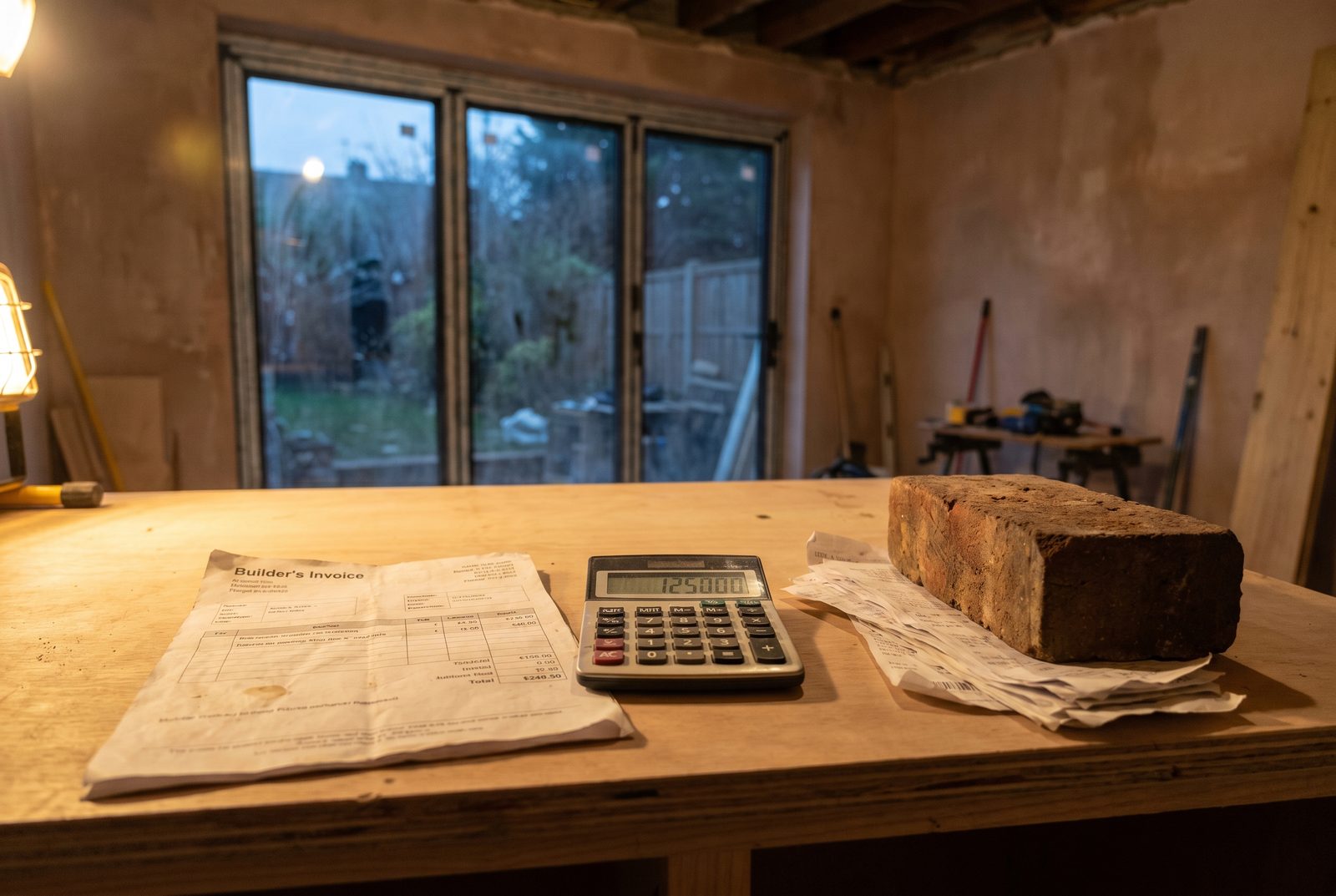
Is VAT Included in Your Extension Quote? The £12,000 Question
A £60,000 quote marked plus VAT really costs £72,000. How the 20% rule works, what a non-VAT builder means, and the written checklist that stops the shock.
Last updated: June 2026 · Figures checked against live North London quotes and current government fee schedules.
Is VAT included in your extension quote?
Quick answer: Often not. VAT-registered builders must charge 20% on extension work, so a £60,000 quote shown ex VAT actually costs £72,000. Reduced 5% and 0% rates do not apply to ordinary home extensions. Get the VAT position confirmed in writing before comparing any prices.
"+VAT" is the most expensive abbreviation in British construction. It hides in the footer of a quote, survives every excited conversation about bifold doors, and resurfaces as a 20% uplift on the first invoice. Homeowner forums carry a steady stream of people who budgeted to the quoted figure and discovered five figures of tax they never planned for — on a £60,000 contract, a £12,000 hole. This guide explains exactly when VAT applies, what it means when a builder does not charge it, and how to make the real number appear before you sign rather than after.
How big is the gap between the quoted price and the real price?
The arithmetic is brutal at extension money. The same headline figure means two very different cheques depending on three small characters:
| Quoted figure | If VAT-inclusive | If "plus VAT" | Hidden difference |
|---|---|---|---|
| £40,000 | £40,000 | £48,000 | £8,000 |
| £60,000 | £60,000 | £72,000 | £12,000 |
| £90,000 | £90,000 | £108,000 | £18,000 |
Consumer-facing prices are supposed to be shown inclusive of VAT, but trade habits die hard and plenty of builders quote net by default. The burden of asking, unfairly, sits with you.
What does the plus-VAT trap look like in real life?
A familiar sequence plays out on homeowner forums every month. A couple set a ceiling of £65,000 — savings plus a £20,000 further advance. The friendliest of their three builders comes in at £62,500 and hands are shaken with relief. Then the deposit invoice lands at £9,375, itemised as £7,812.50 "plus VAT £1,562.50", and only now does the footnote register: every figure in the document was net. The true contract price is £75,000, a £12,500 overshoot, and the options are stripping the lantern and the flooring out of the specification or borrowing again at mortgage rates. Nothing illegal occurred; a trade-style price was simply shown to a retail audience. The prevention costs one sentence in your first enquiry email: please confirm whether your figure is the total payable including VAT.
When must a builder charge VAT?
Registration is compulsory once a business's rolling 12-month turnover passes £90,000 — and extension firms blow through that almost immediately. Materials alone on one £80,000 project can exceed £35,000; run two extensions a year and registration is unavoidable. So the practical rule of thumb: any established firm with employed trades, multiple concurrent sites or a project manager is VAT-registered, and 20% is part of your real price. The only question is whether their paperwork admits it upfront.
What does it mean if a builder does not charge VAT?
It means a small operation — typically a sole trader or two-person band staying under £90,000 of annual turnover, often by working labour-only or running a single job at a time. That is not automatically bad: a genuinely unregistered builder is legitimately 20% cheaper to you, and some of the best small extensions in North London are built exactly this way. But sense-check the claim. A firm fielding three crews and a sign-written fleet cannot plausibly sit under the threshold, and "no VAT if you pay cash" is not a discount — it is evasion that strips out your paper trail. Also ask what happens if they cross the threshold mid-project, because registration part-way through can put 20% on the remaining work unless your contract fixes the price.
Why don't the 5% or 0% VAT rates apply to your extension?
HMRC's reduced rates exist, which is precisely why they mislead. The 5% rate covers specific situations such as renovating a dwelling that has stood empty for two years or more, and conversions that change the number of dwellings in a building. The 0% rate covers new-build homes and certain works to qualifying buildings. An extension to an occupied house matches none of these: it is standard-rated at 20%, full stop. A builder hinting they can "do it at 5%" for a normal extension is either confused or inviting you into a misdeclaration that HMRC can unwind years later — with the assessment landing on the builder but the project chaos landing on you.
How do you stop the VAT surprise? The in-writing checklist
Five lines of paperwork close the trap completely. One: the total contract sum stated in pounds as VAT-inclusive — not "£X plus VAT where applicable". Two: the builder's VAT registration number printed on the quote, which you can verify in seconds on HMRC's online checker. Three: a contract clause confirming the sum includes VAT at the prevailing rate. Four: every invoice showing VAT as a separate line, which you need anyway if you later sell to a buyer who wants evidence of compliant work. Five: if the builder is not registered, written confirmation of that status and of what happens to pricing should they register before completion. Thirty minutes of admin against a £12,000 ambush is the best hourly rate in your whole project.
Frequently asked questions
Can I reclaim VAT on a home extension?
No. Private homeowners cannot recover VAT on extension work, and HMRC's DIY refund scheme applies to new builds and qualifying conversions only. The 20% is a final cost, which is why it belongs in your budget from day one.
Is VAT charged on the whole price or just the labour?
The whole supply — labour, materials, plant and the builder's margin all carry 20% when the firm is registered. There is no carve-out for materials you could theoretically have bought yourself.
What if my builder registers for VAT halfway through the job?
Work invoiced after registration attracts 20% unless your contract fixed a VAT-inclusive total. This is a live risk with fast-growing small firms, so address it in writing at signing rather than negotiating it at second fix.
Is a non-VAT quote automatically 20% cheaper overall?
Only if everything else is equal, which it rarely is. Compare the non-registered £58,000 against the registered quote's gross figure, then check prelims, PC sums and exclusions — a missing scaffold line can quietly eat the entire VAT saving.
Does VAT apply to professional fees as well?
Usually, yes. Architects, structural engineers and surveyors are typically registered, so their £1,200–£2,500 design fees and £500–£1,500 engineering fees generally carry 20% too. Council planning fees, by contrast, carry no VAT.
Every figure The Extension Company quotes is the figure you pay — VAT inside, in writing, fixed. Test your budget with the Extension Builder or book a free site visit with our Cockfosters office on 020 3051 9430.
Thinking about your own extension?
Design yours in the Extension Builder for an honest guide price in 60 seconds — no email needed — or book a free site visit for a fixed, itemised quote from the Pine Grove team.
Or call us — 020 3051 9430
The London extension breakdown, in your inbox
One thoughtful piece a week on what extensions actually cost in London, what councils are approving, and the mistakes worth avoiding. No fluff, no spam, unsubscribe in one click.
We'll only email you about London extensions. Unsubscribe any time.
Explore More House Extension Design Options
Related Articles
Three builders, the same drawings, quotes £40,000 apart. The seven real reasons extension prices diverge in 2026 — and how to compare quotes properly.
Every line a proper extension quote should contain — from preliminaries to finishes — plus the PC sums and exclusions that catch North London homeowners out.
What actually moves a kitchen extension quote in London: structural openings, glazing, roof type, drainage and finishes — plus the fees that are fixed.
Ready to Get Started?
Henry Lewis
Henry Lewis covers UK home extensions, planning permission, and renovation for The Extension Company. He has spent the last decade writing about property and the British housing stock, with a particular focus on how London homeowners navigate the planning system and get the most from their builds.