Loft Conversion Permitted Development Rules 2026
The 2026 permitted development rulebook for loft conversions — volume caps, the principal elevation rule, glazing, and what voids your PD rights.
Last updated: June 2026 · Verified against current government planning rules and North London council records.
What are the permitted development rules for a loft conversion in 2026?
Quick answer: Permitted development lets you convert a loft without planning permission if the added roof volume stays within 40m³ (terraced) or 50m³ (semi or detached), nothing projects forward of the principal elevation, materials match the house, and side windows are obscure-glazed. Article 4 areas and conservation areas override these rights.
Permitted development is the legal shortcut that lets the majority of North London homeowners convert their roofs without ever filing a planning application. But it is a set of conditions, not a blank cheque — break any one of them and the entire conversion falls outside permitted development, exposing you to enforcement. This guide sets out every rule as it stands in 2026, the figures that have changed over the years, and the local restrictions that quietly disable the lot.
What are the volume limits for a loft conversion?
Volume is the headline rule. The additional roof space you create must not exceed a fixed allowance, and that allowance depends on your house type.
| House type | Maximum added roof volume |
|---|---|
| Terraced house | 40m³ |
| Semi-detached house | 50m³ |
| Detached house | 50m³ |
Three things trip people up here. First, the allowance is cumulative for the lifetime of the building — every previous roof addition counts against your total, so a house that already gained 30m³ leaves you only 10m³ on a terrace. Second, the figure measures added volume, not finished room size, so dormer cheeks and the box itself all consume your allowance. Third, the 20m³ figure some older guides cite is an obsolete allowance from a previous version of the rules; the current caps are 40m³ and 50m³.
What is the principal elevation rule?
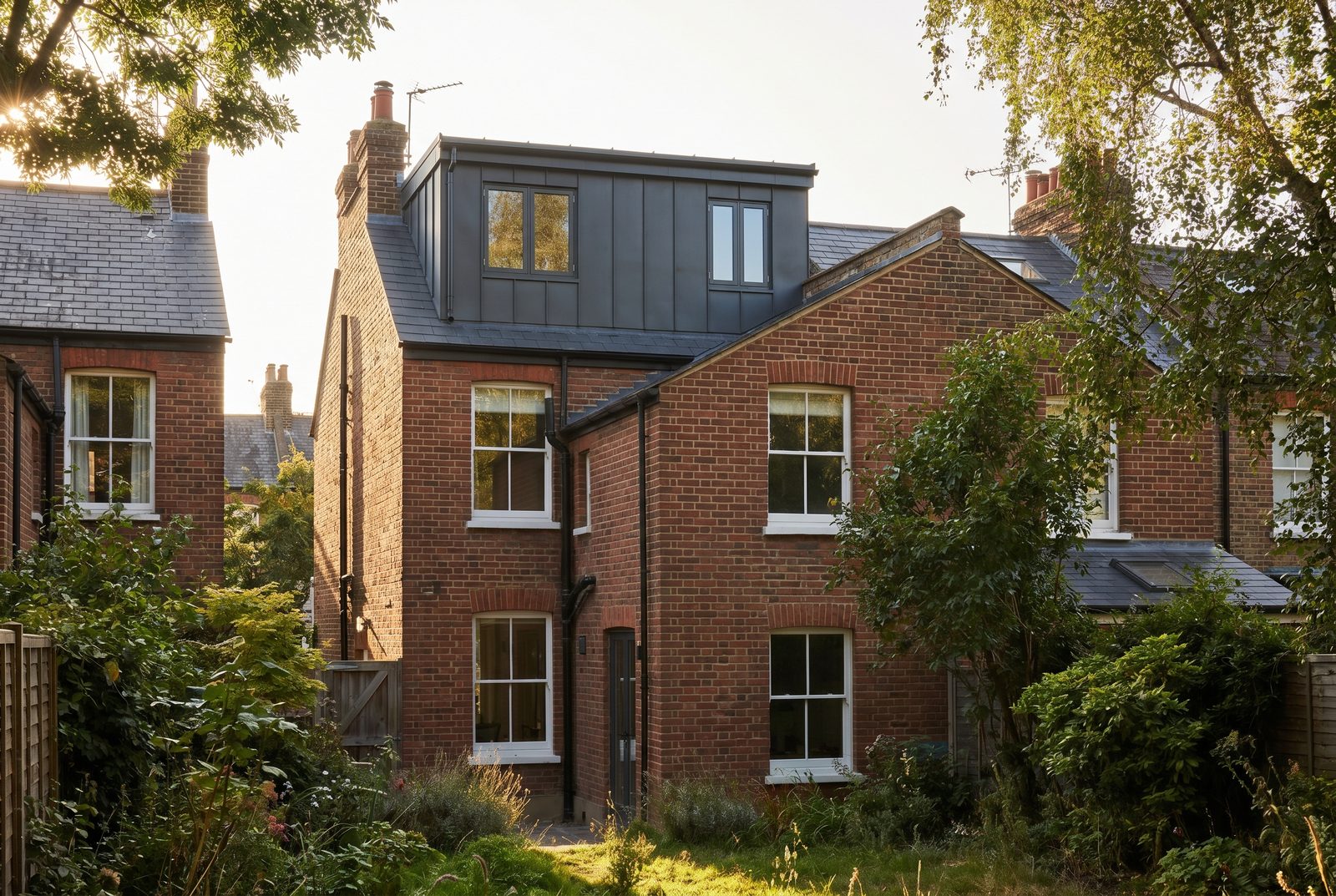
No part of a permitted-development loft conversion may extend beyond the plane of the existing roof slope that faces a highway — in plain terms, you cannot build a dormer or roof addition on the front of the house under permitted development. The principal elevation is the main face of your home, almost always the one fronting the street. This is why hip-to-gable extensions and rear dormers are so common across Enfield and Barnet: they grow the roof at the back and side, where permitted development allows it, leaving the street-facing slope untouched. A front dormer almost always needs a full planning application.
What are the materials and window conditions?
Two finishing conditions complete the permitted-development picture. Materials must be similar in appearance to the existing house — matching tiles, render or brick — so a glaring change of cladding voids your rights. And any window installed in a side-facing roof slope or wall must be obscure-glazed and either non-opening or opening only at a height of at least 1.7m above the floor, to protect neighbours' privacy. Rooflights that sit within 150mm of the existing roof plane and do not project more than 150mm are also expected, keeping additions visually subordinate. Eaves and ridge heights must not be raised above the existing roof's highest part.
What voids your permitted development rights entirely?
Some properties never had loft permitted development rights, or have had them removed. The conversion needs full planning permission if your home is a flat or maisonette (PD covers houses only), is a listed building, sits in a conservation area where roof alterations are restricted, or falls under an Article 4 direction in which the council has formally withdrawn the relevant rights. Around a quarter of North London streets carry one of these constraints. Designed-out areas of outstanding natural beauty and national parks apply elsewhere but rarely in our patch. Always check your specific address — rights can differ house by house within the same postcode.
Frequently asked questions
How do I calculate the volume of my loft conversion?
Volume is the internal cubic capacity of the new roof space measured externally, including dormers. A surveyor or designer calculates it from the proposed cross-section; as a rough guide a generous rear dormer on a London terrace often lands around 25–35m³, leaving little headroom under the 40m³ cap.
Can I add a rear dormer under permitted development?
Usually yes, provided it stays within your volume allowance, does not sit forward of the principal elevation, and you are not in a conservation area or Article 4 zone. Rear dormers are the workhorse of North London loft conversions precisely because they normally qualify.
Do permitted development rights ever expire?
The national rights themselves do not expire, but a council can introduce an Article 4 direction at any time that removes them for a defined area, and conservation area designations can be extended. Check current status before you commit rather than relying on what was true a few years ago.
Is a Lawful Development Certificate proof of permitted development?
Yes. A Lawful Development Certificate (Proposed) costs £274 and is the council's formal confirmation that your scheme is lawful without planning permission. It is the document buyers' solicitors look for, so it is well worth obtaining even when you are confident the rules are met.
The rules read simply but the volume maths and local overrides catch people out. See our full breakdown on the loft conversions hub, or arrange a free site visit and we will measure your roof against the 2026 limits before designing — The Extension Company, Cockfosters, 020 3051 9430.
Related service
Loft Conversions — fixed-price design & buildDormer, hip-to-gable and Velux conversions across North London, with permitted development checked free before you commit.
Thinking about your own extension?
Design yours in the Extension Builder for an honest guide price in 60 seconds — no email needed — or book a free site visit for a fixed, itemised quote from the Pine Grove team.
Or call us — 020 3051 9430
The London extension breakdown, in your inbox
One thoughtful piece a week on what extensions actually cost in London, what councils are approving, and the mistakes worth avoiding. No fluff, no spam, unsubscribe in one click.
We'll only email you about London extensions. Unsubscribe any time.
Explore More House Extension Design Options
Related Articles
2026 update to permitted development rules. Understand what you can build without planning permission and recent changes affecting London homeowners.
Rear dormers are usually permitted development; front dormers almost always need permission. The 2026 rules, volume limits and conservation restrictions.
Every 2026 permitted development limit for London extensions: rear depths, the £249 prior approval route, loft volumes, Article 4 areas and LDCs.
Ready to Get Started?
Henry Lewis
Henry Lewis covers UK home extensions, planning permission, and renovation for The Extension Company. He has spent the last decade writing about property and the British housing stock, with a particular focus on how London homeowners navigate the planning system and get the most from their builds.