Extension vs Moving House: The Honest London Answer
An honest London framework for extend vs move: when moving genuinely wins, when improving does, and how to get a real number before you decide.
Last updated: August 2026 · Verified against current UK building regulations and London planning practice.
Should we extend this house or move?
Quick answer: Improve if the location works and the house has space you can legally unlock — a side return, a loft, a rear extension, or a layout a renovation can fix. Move if you need a different area or school catchment, if the house has already reached its extension ceiling, or if you own a leasehold flat with no realistic right to extend. The sensible way to decide is to establish what your house can take and what that costs as a fixed figure, then set it against what moving actually gets you.
We design and build extensions and whole-house renovations across North London, so you might expect us to say improving always wins. It doesn't — a fair share of the households we visit would be better off moving, and we say so. Here is the framework we use.
When moving genuinely wins
The problem is the location, not the house. No extension shortens a commute or moves you into the catchment for the school you want. In Barnet and Enfield especially, catchment boundaries drive a large share of family moves — and if that is the real motive, a kitchen-diner solves nothing.
The house is at its ceiling. Plenty of Victorian terraces in Haringey and Islington already have the side return infilled and the loft converted. Once those cards are played, a terrace has little left: a second rear storey is rarely consented, and a basement is a different order of undertaking. Every street also has a value ceiling — the price the best house on that road can achieve — and if yours is already near it, extra floor area may never be fully recovered at sale.
You own a leasehold flat. Flats have no permitted development rights, so any extension needs a full planning application plus the freeholder's consent — usually a paid-for licence for alterations. For most London flats the honest answer is that extending is not realistically on the table, and moving is the route to more space.
You want what the plot cannot give. A bigger garden, off-street parking, a detached house. Extensions trade garden for floor area; they never add land.
When improving wins
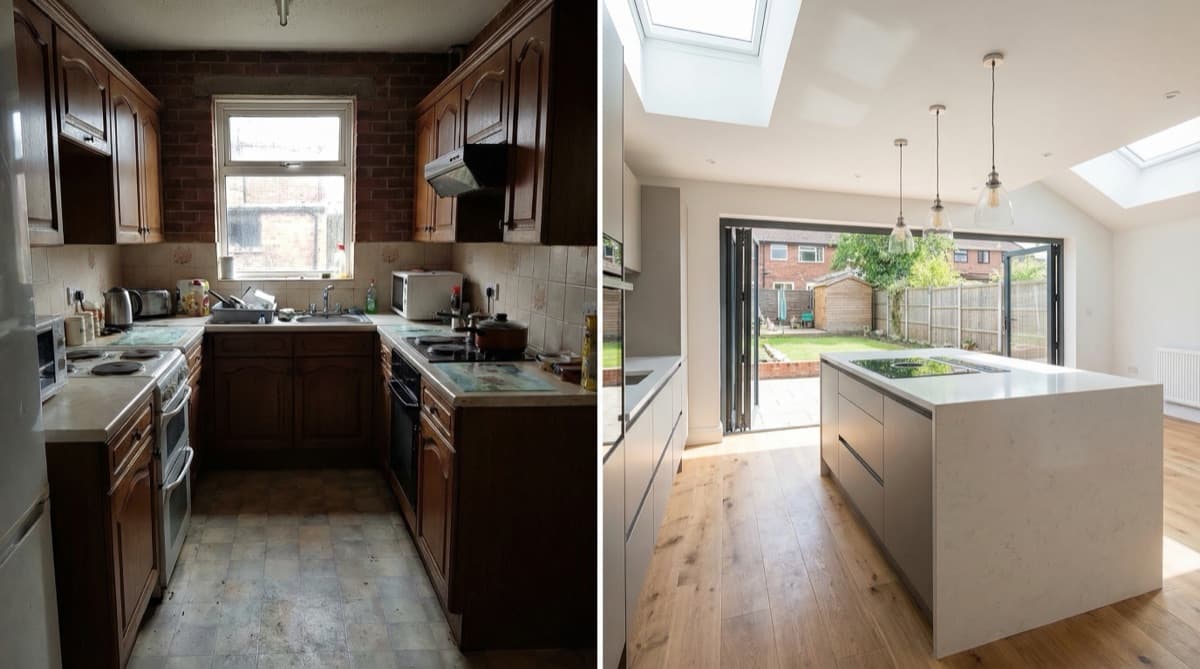
Right location, wrong layout. This is the most common case we see. A 1930s semi in Southgate or Cockfosters with a galley kitchen and a little-used dining room is not short of potential — it is short of one good room. The same goes for an unextended Victorian terrace with a dark side return. If the street, the schools and the neighbours all work, the house is the fixable part: a side return extension unlocks the plan, and a whole-house renovation deals with everything at once where the house needs bringing up to standard anyway.
The transaction stack of moving buys you nothing. Moving carries stamp duty, estate agent fees on the sale, two sets of legal fees, surveys, removals and often storage. Every pound of that stack is consumed by the transaction itself — none of it becomes house. Money spent improving goes into the asset you own. That does not make improving automatically cheaper; it changes what the money does.
You control the outcome. When you improve, you specify the result. When you move, you are limited to whatever comes onto the market in your search area during your window — and in a slow market, the house you want may simply never appear.
The decision factors, side by side
| Factor | Favours moving | Favours improving |
|---|---|---|
| The real motive | Location, catchment or commute | Space, layout or condition |
| Extension potential | Side return and loft already done; house at its ceiling | Unused side return, loft or rear depth still available |
| Tenure | Leasehold flat; freeholder consent unlikely | Freehold house with permitted development rights |
| Street value ceiling | Your house already near the top of the road | Clear headroom between your house and the best on the street |
| Appetite for disruption | Cannot live through a build and have nowhere to decant | Can tolerate a scheduled, finite build |
| Garden and plot | Need more outside space or parking | Willing to trade some garden for floor area |
The variables people underweight
Both routes are disruptive — differently — and people consistently underweight the one they have not lived through. A build means weeks of dust, trades in the house, and usually a stretch without a working kitchen. It is finite and scheduled: with a competent contractor you know roughly when it ends. But it is real, and anyone who tells you otherwise is selling something.
Moving spreads its upheaval across a longer, less controllable arc: months of viewings, a chain you cannot see into, and the abrupt loss of the things you cannot pack — neighbours, a school run that works, a street you know. Be honest about which form of disruption your household will absorb better.
Extend now, move later — does the sequencing work?
Often, yes — provided you build for the market as well as for yourselves. If a move within five to ten years is plausible, favour work with broad appeal: a kitchen-diner across the rear, an extra bathroom, a properly converted loft bedroom. Avoid highly personal layouts a buyer would pay to undo.
Paperwork is what preserves resale flexibility. Work done under permitted development should be evidenced with a Lawful Development Certificate (£274 for a proposed scheme), the build needs a Building Regulations completion certificate, and any party wall awards should be kept on file. Buyers' conveyancers ask for exactly these documents, and a clean folder keeps a future sale simple — one reason we keep drawings, planning and building control in-house.
Price the improve option properly before you decide
Most households make this decision with a real number on one side only: they know what the house would fetch and roughly what the next house up costs, while the improve option is a guess assembled from other people's anecdotes. That is a poor basis for a decision this size.
Do it the other way round. Use our Extension Builder to put together the scheme you actually want, then have us out for a free site visit. We survey the house, our architect team draws what it can take, and you get a fixed, itemised quote covering design, consents and construction before you commit to anything. Our North London cost guide explains what drives the number in the meantime. With a fixed figure for improving next to the full cost of moving, the decision usually makes itself. Book the visit and find out in which direction.
Frequently asked questions
Is it cheaper to extend than to move?
There is no general answer — it depends entirely on the house and the move you are comparing it against. The only reliable way to know is to set a fixed, itemised quote for the work, given after a free site visit, against the full transaction cost of the move you would actually make. Every project we take on is priced as a fixed, itemised quote after a free site visit, which gives you a real figure to set against the cost of moving.
Do I need planning permission before I can compare the options?
No, and you should not spend on an application just to decide. Many rear and side return extensions on North London houses fall under permitted development, and where a full householder application is needed the council's decision period is eight weeks. We advise on the consent route at the site visit.
Can I extend a leasehold flat?
Rarely in practice. Any extension to a flat needs a full planning application plus the freeholder's consent, and freeholders are under no obligation to give it. If you need substantially more space from a flat, moving is usually the realistic answer.
Will an extension add more value than it costs?
It depends on the gap between your house and the ceiling value of your street — a local estate agent can tell you that in one conversation. Where headroom exists, well-built space tends to hold its value; at the ceiling, extend for your own use, not for profit.
What if we extend and then move anyway a few years later?
The work still serves you if it has broad appeal and clean paperwork — a Lawful Development Certificate, a Building Regulations completion certificate, and any party wall awards on file. Those are the documents a buyer's conveyancer asks for, and having them ready keeps the sale straightforward.
Related service
Price the improve option in 60 secondsBefore deciding to move, see what your extension would honestly cost — no email needed.
Planning this where we build?
We design, get planning and build across North London, and work across the rest of London too. Start with your area:
Thinking about your own extension?
Design yours in the Extension Builder for an honest guide price in 60 seconds — no email needed — or book a free site visit for a fixed, itemised quote from the Pine Grove team.
Or call us — 020 3051 9430
The London extension breakdown, in your inbox
One thoughtful piece a week on what extensions actually cost in London, what councils are approving, and the mistakes worth avoiding. No fluff, no spam, unsubscribe in one click.
We'll only email you about London extensions. Unsubscribe any time.
Thomas Mark
Thomas Mark writes and edits The Extension Company's guides to extensions, loft conversions, costs and planning. The Extension Company is the extensions studio of Pine Grove Design & Build, whose own team designs and builds across North London, so the guides start from the questions homeowners ask us and the decisions councils actually publish.