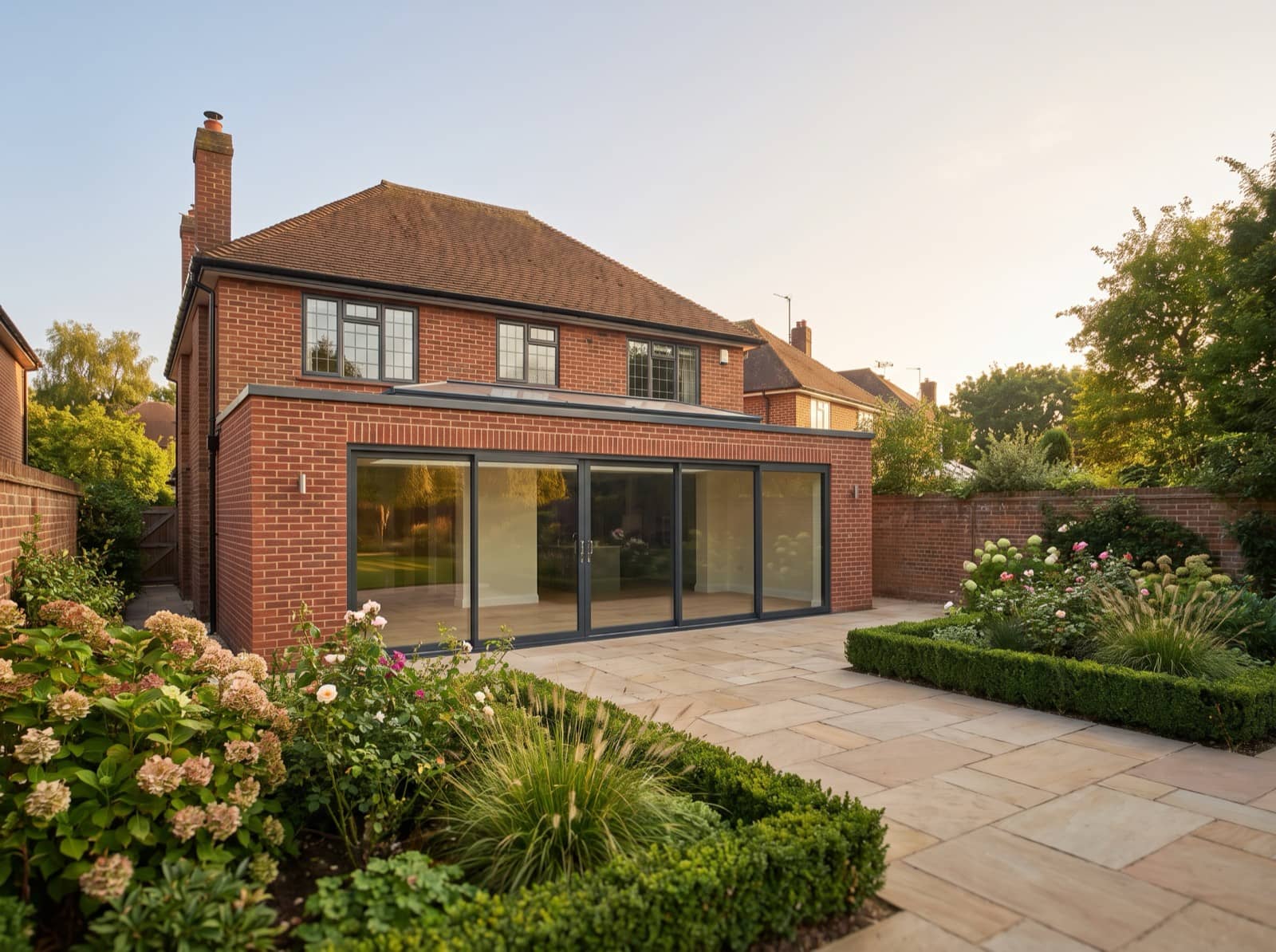
The back of an older London house is usually where it works worst. The kitchen is narrow, the dining room sits on the wrong side of a wall, and the garden is reached through one small door. A single storey fixes that without touching the bedrooms: go out at the rear, fill the passage at the side, or do both in an L. Which of the three suits you depends mostly on the house you start with, so that is where this page starts.
Rear, side or wrap-around: which suits your house
Victorian and Edwardian terraces
A terrace usually has a narrower back addition, the outrigger, with a strip of side passage beside it. That gives three moves. A side return builds over the passage so the kitchen runs the full width of the house and the garden stays as it is; our side return extensions page covers that job in detail. A rear extension pushes out past the end of the outrigger, measured for permitted development from the rear wall of the original house. A wrap-around does both in one L and gives the largest room of the three, but it nearly always needs a householder application, for the reason set out in the planning section below. On a terrace you have neighbours on both sides, so party wall notices usually go to both.
1930s semis
The typical semi has a flat back wall, one shared wall and a side passage or garage on the other flank. The natural scheme is a full-width rear extension off the back wall: 3m under permitted development, up to 6m through prior approval. The side passage can take a single-storey side extension as long as it is no wider than half the original house and no more than 4m high, which suits a utility room, WC or a wider hall to the garden. Joining the two into a wrap-around turns the whole ground floor into one space, and it is normally an application scheme. Only the attached side is a party wall, though digging near the house across the passage can still need a notice.
Detached houses
A detached house gets the larger allowance: 4m at the rear without an application and up to 8m through prior approval. Wider plots take a full-width glazed rear or a wrap-around without crowding the boundaries, and there is often no party wall at all. Two limits still matter: the eaves rule if the extension runs within 2m of a boundary, and the rule that extensions and outbuildings together can cover no more than half the land around the house. On a big garden with a pool house or garden room already built, check that first.
For layouts, roof shapes and glazing ideas for each of these, see our guide to single-storey extension ideas. If the brief is really a new kitchen, the kitchen extensions page covers moving the kitchen into the new space. If you also need a bedroom, a double-storey extension adds it over the same footprint in one build. If the new room is taking the place of an old conservatory, replacing a conservatory with an extension covers what changes for planning, building regulations and the foundations.
What a single-storey extension costs in North London (2026)
Budget £2,800 to £4,200 per m² for the build, excluding VAT, professional fees and kitchen or bathroom fit-out. These are the same figures as our North London extension cost guide, where you will also find costs by area and a full list of what a build price leaves out.
| Extension | Typical size | Build cost, North London 2026 |
|---|---|---|
| Side return | 8–12 m² | £35,000 – £65,000 |
| Single-storey rear | 15–20 m² | £45,000 – £90,000 |
| Wrap-around | 20–30 m² | £70,000 – £140,000 |
By size, at the same per-m² rate:
| Size | Footprint | Build cost |
|---|---|---|
| 3m × 5m | 15m² | £42,000 – £63,000 |
| 4m × 5m | 20m² | £56,000 – £84,000 |
A 20m² rear kitchen extension with a mid-range kitchen typically lands at £75,000 to £110,000 all-in. The kitchen itself (units, worktops and appliances) runs £8,000 to £30,000 depending on spec, and most extension work carries VAT at 20%. The 3m × 5m size has its own worked example in our 3m × 5m extension cost guide.
Within those ranges, the price moves with the width of glazing across the back, the steel needed to take out the old rear wall, foundation depth on North London clay, and access: on a mid-terrace, every barrow of spoil goes out through the house. Nothing on this page is a quote. After a free design visit you get a fixed, itemised price, so the number you sign is the number you pay.
Planning: what permitted development allows
On a house that still has its permitted development rights, a single-storey extension needs no planning application if it stays inside these limits, set by the General Permitted Development Order 2015, Schedule 2, Part 1, Class A:
- Depth: up to 3m beyond the rear wall of the original house on a terrace or semi, and 4m on a detached house.
- Prior approval: up to 6m on a terrace or semi, and 8m on a detached house, through the prior approval process, in which the council notifies the neighbours and judges the effect on them.
- Height: no more than 4m, and no higher than the existing house at eaves or ridge.
- Eaves near a boundary: no more than 3m where the extension is within 2m of a boundary.
- Plot coverage: extensions and outbuildings together may cover no more than half the land around the original house.
- Side extensions: single storey, no more than 4m high and no wider than half the original house.
- Position and materials: nothing forward of the front of the house or of a side wall facing a road, and materials similar in appearance to the existing house.
"Original house" means the house as first built, or as it stood on 1 July 1948, so an extension added by a previous owner may already have used part of the allowance. A wrap-around counts as one extension, and because it goes past a side wall it has to meet the half-width limit as well; an L across the full back of the house cannot, which is why wrap-arounds normally go through a householder application.
Flats and maisonettes have no permitted development for extensions at all. In a conservation area, a single-storey rear extension inside the 3m or 4m limits can still be permitted development, but side extensions, cladding and the 6m or 8m prior approval route are not. An Article 4 direction can remove more: in Barnet, for example, the directions covering parts of the Mill Hill and Finchley Church End conservation areas list the Class A extension right itself among the rights they remove. Our conservation area extensions guide explains how those rules change a design, and we check the position for your exact address before drawing anything.
Which route you take sets the paperwork and the fee:
| Route | Fee | What to expect |
|---|---|---|
| Lawful development certificate (permitted development) | £274 | Optional, but proves the extension is lawful when you come to sell |
| Prior approval, larger home extension | £249 | Neighbours are notified; the council has 42 days to decide |
| Householder planning application | £548 | 8-week statutory decision period from validation |
Building regulations approval is needed whichever route you take. Every fee is set out in our planning fees guide.
Party walls, drains and building control
Most rear extensions on terraces and semis fall under the Party Wall etc. Act 1996. A new wall built on the boundary needs one month's notice, and so does digging within 3m of a neighbour's building to a depth below its foundations. Work to the shared wall itself, such as bearing a steel into it, needs two months. For work to the shared wall or for excavation, a neighbour who does not reply within 14 days is treated as being in dispute, and surveyors then settle the award. Written consent avoids that. Our party wall guide covers the full process.
Drains decide more rear extensions than people expect. Behind a terrace, one sewer often serves several houses, and if a public sewer runs under the new footprint or within 3m of it, the water company's build-over agreement is needed before work starts. Building control then signs off the foundations, the steels, the insulation and the drainage as the job goes up.
How we run a single-storey extension
The Extension Company is the extensions studio of Pine Grove Design & Build Ltd, and North London projects are designed, managed and built by Pine Grove's own team. The process is the same whichever shape you choose:
- Free design visit. We measure the back of the house, check the boundaries and where the drains run, and tell you which planning route applies.
- Design and drawings. Layout, steels and glazing are drawn before anything is priced, so the quote covers the scheme you actually want.
- Consents. Certificate, prior approval or householder application, with party wall notices served at the same time so the two clocks run together.
- Fixed, itemised quote. Every element priced, before you commit to anything.
- Build. In North London, Pine Grove's own team builds it, from foundations to handover.
Want a rough figure first? The Extension Builder prices your size and shows the likely planning route.