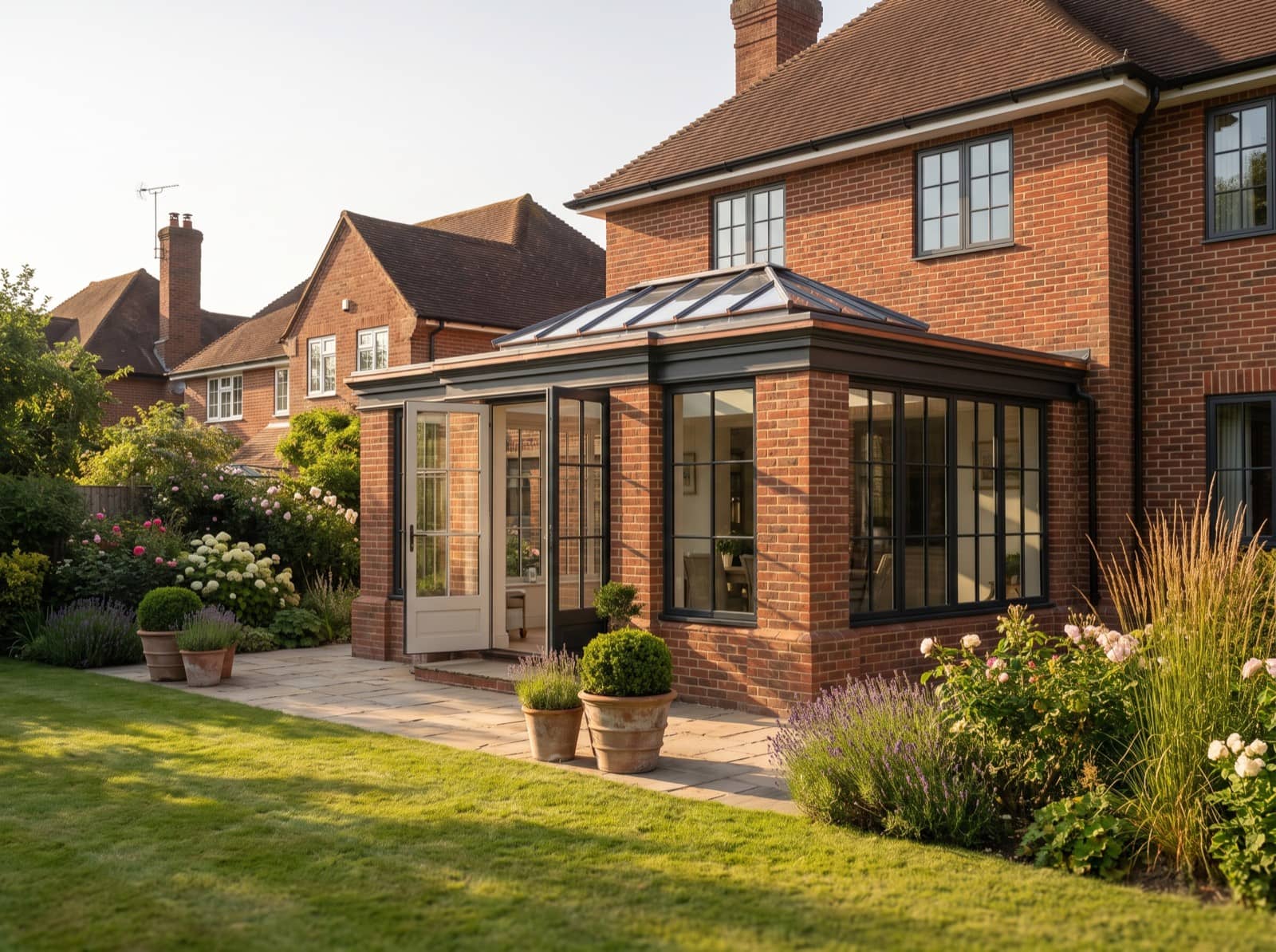
Orangery prices quoted online vary widely because the word covers two different products. One is a conservatory with a deeper roof edge, priced like a conservatory. The other is a brick-built room with an insulated roof and a glazed lantern, designed, inspected and certified as an extension. This guide prices the second kind: what it costs by size and per m², what moves the figure, how it compares with a conservatory and an extension, and what the build price leaves out. For the design side, see our orangeries page.
How much does an orangery cost in 2026?
These are realistic build ranges for London, excluding VAT, professional fees and any kitchen fit-out:
| Orangery | What it is | Typical build cost, 2026 |
|---|---|---|
| Classic orangery | Brick piers, lantern roof, French or sliding doors, about 20 to 30m² | £60,000 – £95,000 |
| Large orangery | Wider spans, structural glazing between the piers, about 30 to 45m² | £85,000 – £130,000 |
| Orangery within a bigger programme | Part of a wrap-around or whole-house scheme | Priced on design |
The build figure covers the build itself: groundwork, masonry, the insulated roof and lantern, glazing and doors, and plastering. It does not cover the kitchen, VAT or the professional fees, which are set out further down. These are guide figures, not a quote: the fixed, itemised price comes after a free design visit.
Orangery cost by size
An orangery is built and certified as a single-storey extension, so the per m² rate for extensions is the right cross-check on any orangery price. This table sets the orangery bands beside the build cost of a single-storey extension of the same footprint from our North London extension cost guide, which uses £2,800 to £4,200 per m².
| Footprint | Orangery band | Single-storey extension, same footprint |
|---|---|---|
| 4m × 5m, 20m² | Classic: £60,000 – £95,000 | £56,000 – £84,000 |
| 4m × 6m, 24m² | Classic: £60,000 – £95,000 | £67,000 – £100,000 |
Two things to take from it. The orangery bands overlap the extension ranges rather than sitting below them, so an orangery is not a cheap way to get an extension. And where a footprint sits within its band depends on specification more than on floor area, which is what the rest of this guide is about.
We publish no orangery band below about 20m². The extension rate is the nearest guide there: 15m² is £42,000 to £63,000 to build. The lantern, the piers and the detailing do not get much cheaper as the floor shrinks, so expect a small orangery to price toward the top of its row.
Orangery cost per m²
Divide the two bands by their sizes and you get the rate:
- Classic orangery: £60,000 over 20m² is £3,000 per m², and £95,000 over 30m² is about £3,170 per m².
- Large orangery: £85,000 over 30m² is about £2,830 per m², and £130,000 over 45m² is about £2,890 per m².
So a working figure is roughly £2,800 to £3,200 per m². That is arithmetic on the two bands, not a separate price list, and the larger rooms come out slightly lower per m² because costs such as the lantern and the opening into the house do not grow in step with the floor. That sits in the lower half of the £2,800 to £4,200 per m² we use for single-storey extensions in North London. A small orangery at a high specification, or one on a difficult site, moves toward the top of that wider range.
Use the rate to test a quote. A price far below £2,800 per m² for a brick-built, insulated, lantern-roofed room usually means something is missing: the foundations, the finish inside, or the building regulations approval that separates an orangery from a conservatory.
What drives the cost of an orangery
The roof lantern. Its size is one of the biggest swing factors in the price. A bigger lantern means more glazing, more structure to trim the opening in the flat roof, and more insulation elsewhere to balance the heat lost through the glass.
The glazing. Standard French or sliding doors between the piers sit at the classic end. Structural glazing across wider spans is what moves an orangery into the large band. On our kitchen extension budgets the glazing line alone, covering structural glazing, bifolds and roof lights, runs £3,000 to £15,000.
Brickwork and detailing. An orangery is judged on how well it matches the house. Handmade brick, stone cills, a brick parapet with copings and hardwood joinery all push toward the top of the band.
The kitchen. Many orangery briefs are kitchen briefs, with the lantern over the island or the dining table. The kitchen itself is on top of the build figure: typically £8,000 to £30,000 depending on spec.
The opening into the house. Taking out the back wall so the orangery opens into the kitchen needs steel, designed by a structural engineer and approved by building control.
Ground and access. Foundation depth on North London clay and the route in and out both affect the price. A garden reached only through the house makes every delivery and every load of spoil slower.
Specification overall. On our extension figures the same footprint can vary by 40% or more between a practical family finish and a high-end scheme. An orangery is no different.
Orangery roof costs: lantern, flat roof and parapet
The roof is what makes an orangery an orangery, and it is where a good share of the money goes. It has three parts.
- The flat perimeter roof. Insulated, carried on the brick corners and piers, and deep enough inside to take lighting and extraction. This is conventional flat-roof construction.
- The lantern. The glazed centrepiece. Cost rises with its length and width, and with the glass specification.
- The edge. A plain fascia is the simpler finish. A brick parapet capped with copings that line through with the house costs more in brickwork and flashings, and gives the classic orangery profile.
Two rules shape the roof as well as the budget. For planning, the whole orangery, lantern included, has to stay within 4m high to remain permitted development. For building regulations, glazing in an extension is limited to 25% of the floor area plus any openings the extension covers, unless the design makes up for the extra glass with better insulation elsewhere. A very large lantern therefore costs twice: once for the glass, and once for the insulation that balances it. Our orangeries page covers how the roof is designed.
Orangery vs conservatory vs extension: cost compared
| Conservatory | Orangery | Single-storey extension | |
|---|---|---|---|
| Build cost, 2026 | The cheapest of the three. We publish no conservatory price | £60,000 – £95,000 for about 20 to 30m² | £45,000 – £90,000 for 15 to 20m² |
| Rate per m² | Not published | Roughly £2,800 – £3,200 | £2,800 – £4,200 |
| Why it costs what it does | Glazed frames on a light base, and exempt from building regulations while it stays behind its own doors | Masonry, insulated roof and lantern, built to full building regulations | Solid walls and roof, built to full building regulations |
| Open to the house | No | Yes | Yes |
| Usable all year | Spring and autumn without help; hot in July and cold in January | Close to normal room comfort | Yes |
The gap between a conservatory and an orangery is the gap between a glazed frame and a building. A conservatory avoids foundations to extension standard, the insulation, the inspections and the brickwork, which is why it costs less and why it cannot be opened into the kitchen. The gap between an orangery and an extension is small. The foundations, the structure and the approvals are the same, and the difference is where the specification goes: the lantern and brick detailing on one, the roof and glazed doors on the other.
If you already have a conservatory and are weighing up what to put in its place, our guide to replacing a conservatory with an extension covers the planning position, the building regulations and whether the old base can be reused.
What the build price leaves out
- VAT. Most extension work, orangeries included, carries VAT at 20%.
- Professional fees. Design, structural engineering, building control and any party wall surveyors. Budget 10 to 18% on top of the build for a properly run project.
- The kitchen. £8,000 to £30,000 where the orangery is a kitchen or takes part of one.
To see how those add up, take the 4m × 5m row in the size table of our North London cost guide: a build cost of £56,000 to £84,000 becomes a realistic all-in figure of £75,000 to £110,000 once typical professional fees and VAT are added. An orangery's extras scale the same way, so when you compare two quotes, compare what is in them.
Planning and building control fees for an orangery
Planning has no separate category for orangeries: an orangery is a single-storey extension, and many need no planning application. Up to 3m beyond the original rear wall on a terraced or semi-detached house, or 4m on a detached one, it can be permitted development. The orangeries page sets out the full limits. Whichever route applies, these are the fees:
| Item | Fee | When it applies |
|---|---|---|
| Lawful development certificate | £274 | Permitted development. Optional, and worth having as proof when you sell |
| Prior approval, larger home extension | £249 | 3m to 6m deep on a terrace or semi, 4m to 8m on a detached house. The council has 42 days |
| Householder planning application | £548 | Beyond those limits. Eight-week statutory decision period |
| Planning Portal charge | £91.02 | Added to online applications unless the council is paid directly |
| Building control | £500 – £1,500 | Every orangery, whatever the planning route |
In a conservation area the prior approval route is not available, so a deeper orangery there needs the householder application. Every fee, with the ones for engineers and party wall surveyors, is in our planning fees guide.
How to get an accurate orangery price
Published ranges get you to a ballpark. The real number depends on things no table can see: the ground, the access, the wall the orangery opens through, the lantern you want and the brick it has to match. The Extension Builder gives a rough figure for a rear extension with a flat roof and lantern at your size. After that, a free design visit leads to a fixed, itemised quote, so the number you sign is the number you pay. North London projects are designed, managed and built by Pine Grove's own team.
Want a real number for your orangery? See how we design them on the orangeries page, check the wider picture in the North London extension cost guide, or book a free design visit for a fixed, itemised quote. Call 020 3051 9430 to speak to the team.